
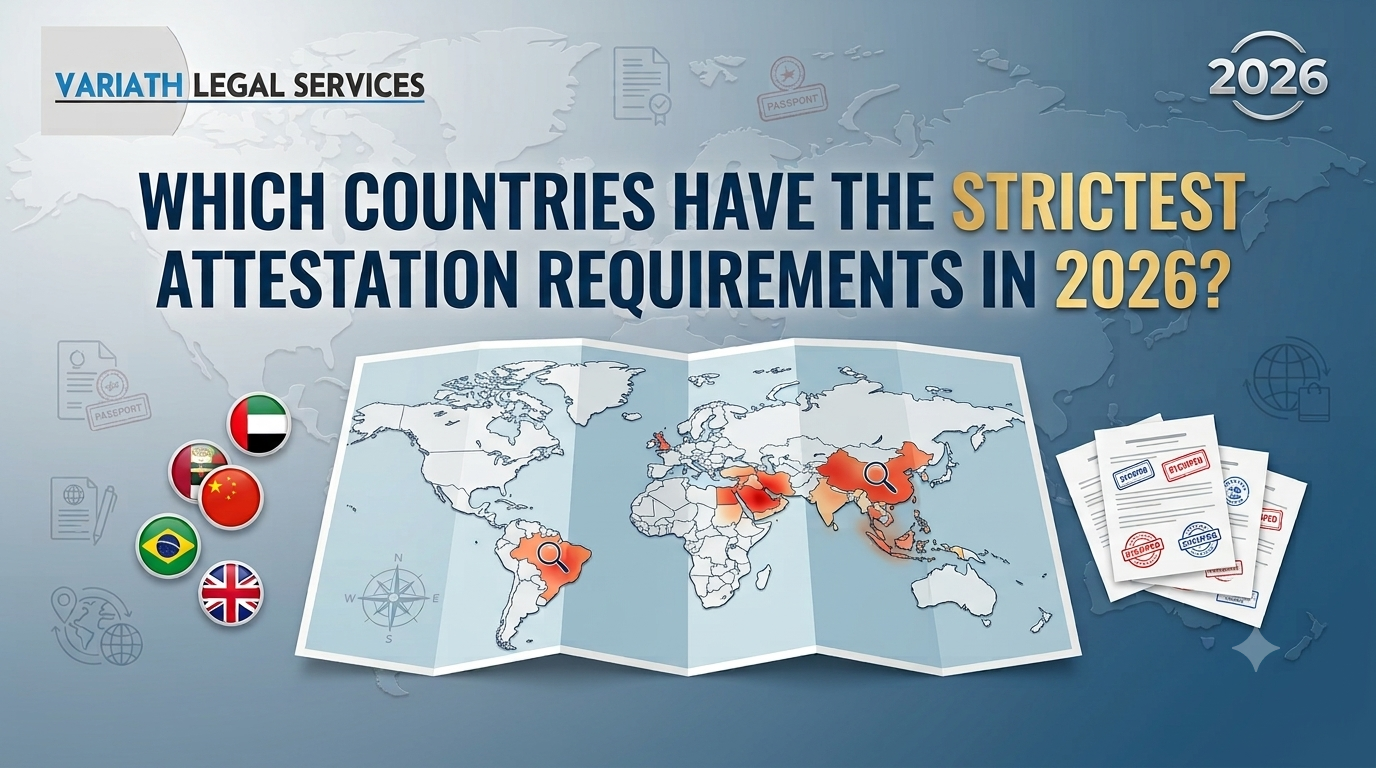
Which Countries Have the Strictest Attestation Requirements in 2026?
If you’ve ever attested a certificate for one country and assumed the process would be just as simple for another, you’ve probably already learned the hard way that it isn’t. Attestation is not a single global standard — it’s a patchwork of national systems, and some countries make you work a lot harder than others to prove your documents are genuine.
This is also why certificate attestation in India looks so different depending on your destination country. The Indian side of the process — HRD, MEA, and embassy attestation — stays largely the same, but what happens once your certificate reaches the destination country varies enormously. At VLS International, we’ve spent nearly two decades managing certificate attestation in India for clients heading to the Gulf, Southeast Asia, and beyond. Based on that experience, here’s an honest look at which countries have the toughest, slowest, and most document-sensitive attestation systems in 2026 — and why.
Why Some Countries Are Stricter Than Others
The biggest factor is whether a country is part of the Hague Apostille Convention. Member countries accept a single apostille stamp from the origin country’s designated authority (in India, this is the MEA) and require nothing further. Non-member countries don’t recognize the apostille at all — they insist on full consular legalisation, meaning your certificate has to pass through your home country’s foreign ministry and the destination country’s embassy before it’s accepted.
Almost every country widely regarded as “strict” on attestation is a non-Hague country. That single fact explains most of the extra steps, extra cost, and extra waiting time applicants run into — and it’s the first thing we check when someone comes to us for certificate attestation in India, since it determines whether the process ends with a single apostille or a full embassy legalisation chain.
The Strictest Countries for Certificate Attestation
1. Saudi Arabia
Saudi Arabia consistently tops the list. It is not a Hague Convention member, so every document needs the full chain: home-country attestation, Saudi Cultural Attaché verification for educational certificates, Saudi Embassy attestation, and finally MOFA Saudi attestation once the document reaches the Kingdom. Educational certificates go through an additional layer — the Ministry of Education’s equivalency and classification review — before they’re considered valid for employment or academic use. The Cultural Mission’s fees are also among the highest in the Gulf, and even minor formatting inconsistencies on a certificate can trigger a rejection and a restart from step one.
2. United Arab Emirates
The UAE runs one of the most document-sensitive verification systems anywhere, even though its process is comparatively fast once you understand it. Supporting documents — provisional certificates, bonafide letters, consolidated mark sheets — often need to be attested alongside the main certificate, not just the primary degree or diploma. UAE authorities are known for rejecting documents over small inconsistencies in names, seals, or issuing authority signatures that other countries wouldn’t flag.
3. Qatar
Qatar requires both Qatar Embassy attestation and Qatar MOFA attestation once documents arrive in-country. School-level and higher-education certificates go through the Supreme Education Council for assessment, which is thorough and closely tied to Qatar’s national qualifications framework — a step that adds time compared to countries with a lighter equivalency process.
4. Kuwait and Oman
Both follow the same non-Hague consular legalisation pattern as their Gulf neighbours: home-country attestation, embassy attestation, and destination-country ministry attestation. Kuwait in particular has strict scrutiny around employment and professional certificates, especially for medical and engineering qualifications, where licensing bodies often require additional verification beyond standard attestation.
5. China
China exited its brief window of Hague membership complications and now runs a demanding consular legalisation process for foreign documents, especially for work visas and long-term residence applications. Documentation requirements can vary by province, and Chinese authorities are known for requesting notarized translations alongside the attested originals.
6. Vietnam
Vietnam is not a full Hague Convention member for all document categories in practice, and its legalisation process for foreign certificates — particularly employment and educational documents — involves both the issuing country’s foreign ministry and the Vietnamese Embassy, with translation requirements adding another layer.
An Important Nuance: There’s No “GCC Passport” for Attestation
One mistake we see constantly: applicants assume that once a certificate is attested for one Gulf country, it’s valid across the region. It isn’t. Despite years of GCC economic integration, there is still no reciprocal recognition of attestation between UAE, Saudi Arabia, Qatar, Kuwait, Bahrain, and Oman. Each country requires its own embassy and ministry attestation, built on the same home-country base. If you’re likely to work across multiple Gulf countries over your career, it’s worth keeping multiple original certificates on hand so you can run separate attestation chains as opportunities come up, rather than needing your only original re-processed each time.
Countries That Make It Easy (For Comparison)
On the other end of the spectrum, most Hague Convention member countries — including the UK, most of the EU, Australia, and increasingly more Asian and African nations — only require a single apostille stamp from the MEA. No embassy visit, no destination-country ministry, no cultural attaché review. It’s a genuinely different experience, which is exactly why understanding your destination country’s status before you start the process saves so much time.
What This Means If You’re Applying to a Strict-Attestation Country
If your documents are headed to Saudi Arabia, the UAE, Qatar, Kuwait, Oman, China, or Vietnam, plan for:
- Longer timelines — often 10–20 working days once the full chain is factored in
- Higher costs, particularly for Saudi Arabia’s Cultural Attaché fees
- Zero tolerance for inconsistencies — a mismatched name, an expired stamp, or a missing supporting document can send you back to square one
- No shortcuts between countries — a certificate attested for Qatar isn’t valid for Saudi Arabia, and vice versa
How VLS International Helps
Certificate attestation for a strict-requirement country isn’t something to figure out on the fly. At Variath Legal Services, we specialize in certificate attestation in India for UAE, Saudi Arabia, Kuwait, Qatar, Bahrain, Malaysia, and beyond, with offices in Delhi, Mumbai, Bangalore, Chennai, and Hyderabad. We manage the full chain — HRD, MEA, and embassy attestation — so a single missed step doesn’t cost you weeks of delay.
If you’re preparing documents for one of the countries above, get in touch with our team before you start the process. Whether you need certificate attestation in India for a single degree certificate or bulk documentation for a company, a quick check on requirements upfront is far cheaper than a rejected certificate later.
Variath Legal Services (VLS International) is an MEA-approved attestation agency with over 19 years of experience helping individuals and businesses authenticate documents for international use.